
This is the second post for the “Primer in Brief” section of the Trump Weekly Primer, which provides an updated view of key White House policies. It is built on the foundations of Trump 2.5: A Primer. A new policy area will be updated weekly, starting May 14, with some initial open posts prior to that.
Note that this is an open preview, and future posts will be available for paid subscribers.
Category: Foreign Policy (Last Updated May 10, 2026)
The administration is pursuing American dominance in the Western Hemisphere and the removal of influence by other major global powers in adversarial states and allies alike.
The Starting Point
At the outset of the administration, it was immediately clear that the focus was on prioritizing not just America-friendly governments but also Trump-friendly leaders. The first-order concern – borders and immigration – was achieved relatively quickly within three months. This opened the door to pursuing the overall objective of hegemony early on in the administration.
Excerpt #1: P. 66 | Chapter III: Principles and Policies
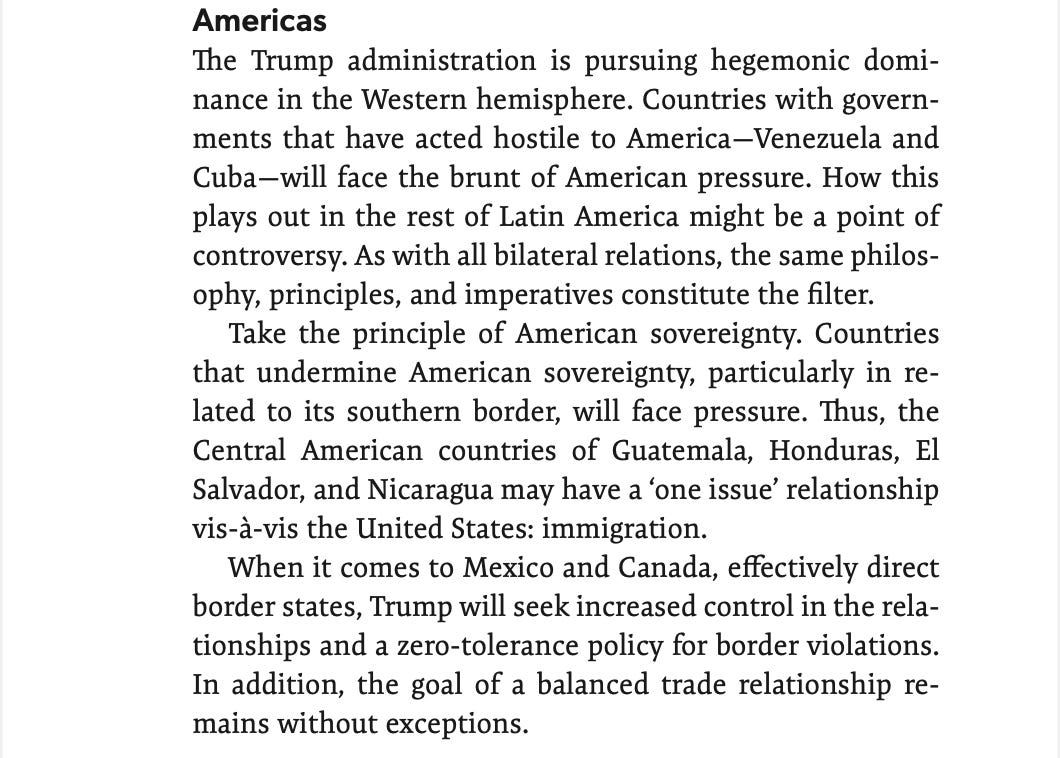
“As the U.S. in the Trump 2.5 era seeks Western hegemonic dominance, it will not accept Chinese influence in Cuba and Venezuela. In Cuba’s case, given its proximity to the U.S. border, there may even be hints at regime change through economic pressure.”
Excerpt #2: p. 67 | Chapter III: “Principles and Policies”
The Current Read
The White House formalized its policy in the Western hemisphere within two key documents: National Security Strategy and the National Defense Strategy.
The approach is characterized as an expanded Monroe doctrine, which has also been reframed in the media as the ‘Donroe’ doctrine. At the core is the reinforcement of a zone of exclusion in the Americas, whereby the United States’ writ is paramount, particularly in confronting Chinese (and at times Russian) influence.
There are other overriding concerns that precipitate American action or intervention:
Interdiction of the drug trade
Combating illegal migration
Achieving geostrategic energy dominance
To achieve these aims, there are ongoing attempts at regime alteration, either through the electoral process or outside it. This played out in Honduras (electorally) and Venezuela (militarily) within the first year, for example. Brazil and Colombia will soon be significant tests for the White House’s approach. In fact, every electoral cycle could be a flashpoint.
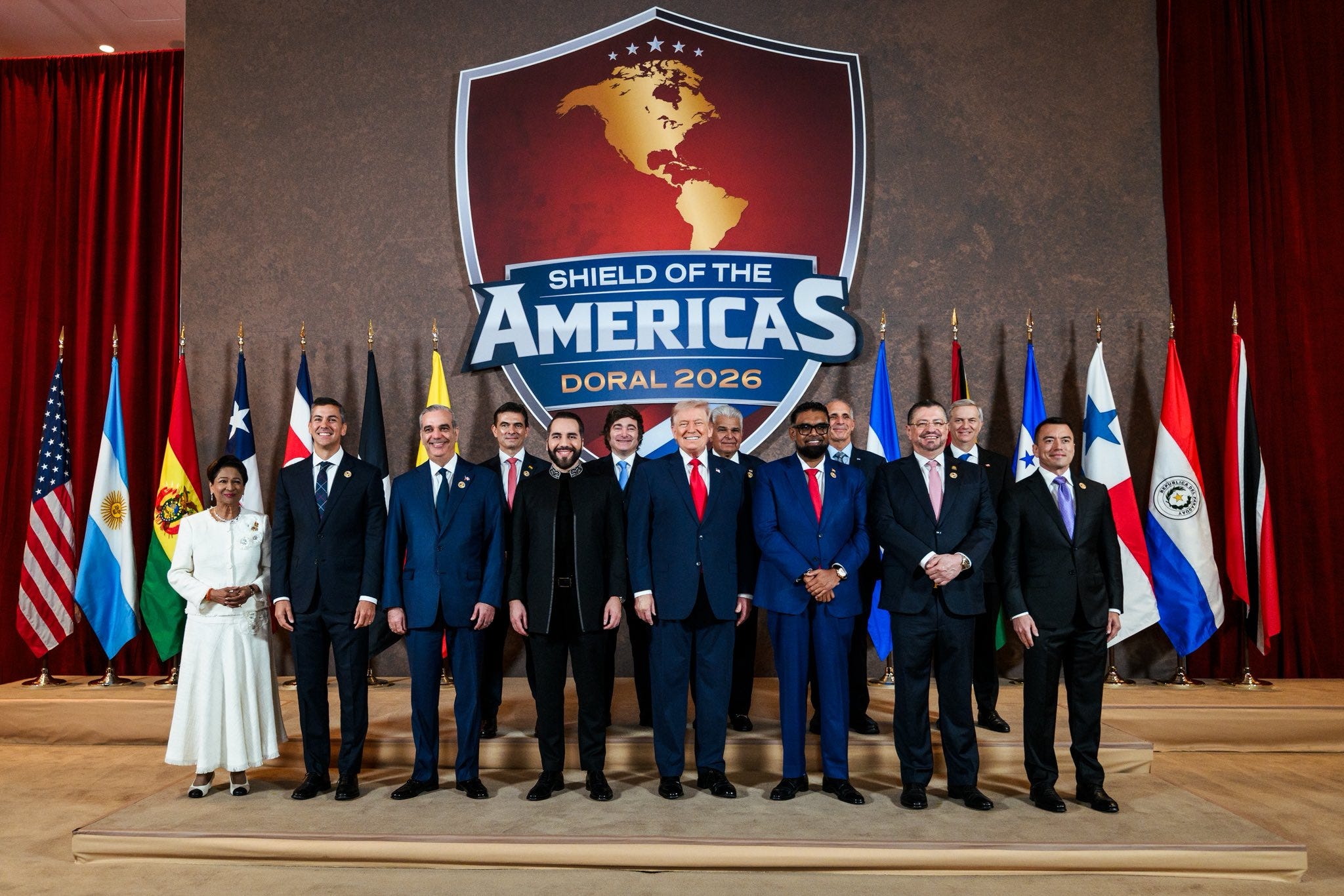
It is less clear what role the Shield of the Americas, a new body, will evolve into and if it will transition beyond pageantry into substance. The primary interlocutors for the United States in co-leadership are El Salvador, Argentina, and Chile, and to a lesser degree, Ecuador and other Central American countries. Canada and Mexico, while within the Americas, have a broader policy context for the administration as the only two countries bordering the United States.
Finally, as in all other regions, advancing American prosperity and achieving a trade surplus, including through tariffs, is also the policy du jour in the Americas.
People shaping the policy*
Marco Rubio, Secretary of State
Pete Hegseth, Secretary of War
Scott Bessent, Secretary of the Treasury
Michael Jensen, Senior Director, National Security Council
Kirsti Noem, Special Envoy, Shield of the Americas
*Further background for individuals available in Trump 2.5
Notable milestones
Ecuador Election (runoff) – April 13, 2025
Chile Election – November 16, 2025
Honduras Election – November 30, 2025
Venezuela Intervention – January 3, 2026
Costa Rica Election – February 1, 2026
Shield of the Americas Summit – March 7, 2026
Colombia Election – May 31, 2026
Peru Election (Runoff) – June 7, 2026
Brazil Election – October 4, 2026
Argentina Election – October 24, 2027
Additional Resources
GEOPOLITICO | Victory in Venezuela
White House | National Security Strategy (November 2025)
Bloomberg | How Trump’s Venezuela intervention revived the Monroe Doctrine