
This is the third post for the “Primer in Brief” section of the Trump Weekly Primer, which provides an updated view of key White House policies. It is built on the foundations of Trump 2.5: A Primer. New policy areas are updated several times each month.
Note that this is an open preview, and the archive will be available for paid subscribers.
Category: Domestic Policy (Last Updated May 25, 2026)
In the first year of the administration, the government pivoted from establishing a sovereign wealth fund to enabling different parts of the government to take direct equity stakes, with the Development Finance Corporation (DFC) in the lead.
The Starting Point
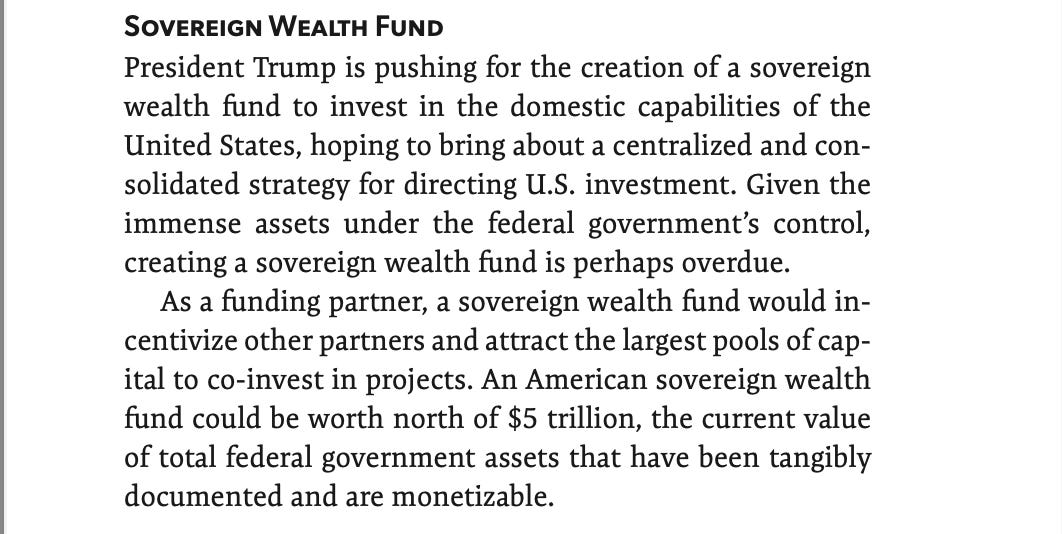
The initial focus of the White House, as emphasized during the campaign, was exploring the establishment of a sovereign wealth fund. On February 3, 2025, Executive Order 14196 was signed to support that initiative.
Excerpt #1: P. 70 | Chapter III: “Principles and Policies”
“In creating a sovereign wealth fund, the Trump administration will seek to partner with the largest sovereign wealth funds in the Gulf to bring investment into America. There will be a steady stream of private sector engagement, just as in the first term.”
Excerpt #2: p. 72 | Chapter III: “Principles and Policies”
The Current Read
Establishing a sovereign wealth fund and consolidating existing assets has proven to be a tall order that would require complex legislation. Instead of that pursuit, the Trump administration has enabled multiple government agencies and departments to build a portfolio of holdings through a range of instruments, including direct equity ownership.
The Development Finance Corporation, through the National Defense Authorization Act (NDAA) passed late last year, now has a revolving $5 billion equity account at the US Department of the Treasury. In addition, it is permitted to have up to $200 billion of total holdings, with up to $70 billion in equity. In that sense, DFC is taking on the standing of a sovereign fund. Its remit has also expanded beyond developing markets to include U.S. allies.
The focus of the DFC, as well as the government's overall holdings, is on critical technology sectors and upstream requirements, such as critical minerals. The US Treasury, the Department of Commerce, and the Department of War (DoW) are also active on this front. While the Intel announcement, in which the US government acquired a stake in the company, took prominence, subsequent deals in quantum computing and critical minerals have shown this is a pattern. In these types of agreements, Commerce and the DoW seem to be more active than DFC.
The sprawl of activity and holdings may require consolidation, at which point an SWF may come back into the spotlight. For now, tracking the hydra of holdings requires careful attention.
People shaping the policy*
Benjamin Black, CEO DFC
Howard Lutnick, Secretary of Commerce
Scott Bessent, Treasury Secretary
Steve Feinberg, Deputy Secretary of War
Jacob Helberg, Under Secretary of State for Economic Growth
*Further background for individuals available in Trump 2.5
Notable milestones
SWF Executive Order – February 3, 2025
Intel Stake Acquired – August 22, 2025
Korea Zinc Deal Announced – December 14, 2025
NDAA 2026 Passed – December 18, 2025
Quantum Computing Grants – May 21, 2026
Additional Resources
Council on Foreign Relations | Washington’s Growing Portfolio: Tracking U.S. Government Investments